Basta!
Loudspeaker simulator
Technical documentation
Ó Tolvan
Data 2005
2007-01-13
Basta!
Basta! is a computer
program for simulation and measurement of loudspeaker systems. It can simulate
closed, bass-reflex, 1-port bandpass and 2-port bandpass systems. It can derive
amplitude and phase response as a function of frequency for these systems. It
manages multiple elements, both in parallel and isobaric operation.
Simulation
The model used in
Basta! assumes a signal (voltage) source followed by an optional set of active
crossover filters, a power amplifier, a passive electric circuit which feeds a
voltage to the loudspeaker. The loudspeaker feeds an acoustic flow into the
box, which in turn feeds an acoustic flow into the radiation resistance. Some
of this flow may originate directly from the loudspeaker. The power produced in
the radiation resistance is the acoustic power generated by the system.

Block diagram for the Basta! simulation.
In the following,
the parts of the simulation are described in detail.
Signal source
The signal source is a
simple voltage source. By changing the voltage, the output level of the
loudspeaker will change. The voltage can also be set to a negative value in
order to simulate reversed polarity of the speaker.
Active filter
Active filters are
typically connected before the power amplifier. Basta! allows high- and lowpass
filters of order 1 to 4. A lookup table for butterworth (odd order) or linkwitz
(even order) filters, is included.
The filters are
realised as follows:
First order One first order link
Second order One second order link
Third order One second order link and one first order
link
Fourth order Two second order links
First and second order
links can typically be realised by means of operational amplifiers and a few
passive components. In the following, examples are given on how to realise the
circuitry.
First order low pass filter
The first order filter
is realised by means of an RC link and a voltage follower.
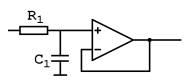
Example realisation of a first order low pass filter
The transfer function
is
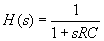
The cut-off frequency
is given by

Select R1=10
kW, and calculate C1 = 1/(2pf0R1)
First order high pass filter
The first order filter
is realised by means of an CR link and a voltage follower.
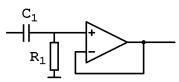
Example realisation of a first order high pass filter
The transfer function
is

The cut-off frequency
is given by

Select R1=10
kW, and calculate C1 = 1/(2pf0R1)
Second order low pass filter
The second order
filter is realised by means of an RC network and a voltage follower.
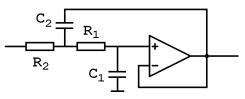
Example realisation of a second order low pass filter
The transfer function
is

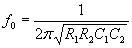
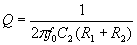
The cut-off frequency
and Q value are given by
Select R1 =
R2 = R =10 kW, calculate C1 = Q/(pf0R), C2 = 1/(4pf0RQ)
Second order high pass filter
The second order
filter is realised by means of an RC network and a voltage follower.
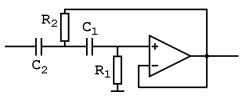
Example realisation of a second order high pass filter
The transfer function
is

The cut-off frequency
and Q value are given by
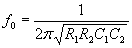
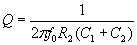
Select R2
=10 kW, calculate R1 = R2/(4Q2) and
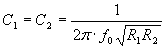
Third order filters
The third order filter is realised by cascading a first order filter with a second order filter.
Fourth order filters
The fourth order
filter are realised by cascading two second order filters.
Power amplifier
For the normal
configuration, the power amplifier has little purpose in Basta!. It is assumed
to be an ideal voltage follower, ie gain =1 and output impedance = 0. However,
when the AC-bass* configuration is simulated, an AC-bass network is connected
to the output of the voltage follower.
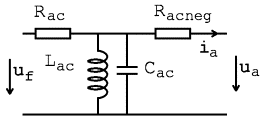
It can be seen that if
Racneg equals -RE of the voice coil, they will cancel,
and Lac and Cac will have the same effect on the response
as a spring and a mass on the mechanical side. Rac will become the
new effective voice coil resistance. Thus, the AC-bass principle can be used to
control the apparent mechanical mass, compliance and lossiness, or in other
words, fs, Vas and Qts can be selected freely.
The AC-bass network is
typically not built like the network above; it is normally included in the
power amplifier using current feedback to design an output impedance like in
the figure.
When the AC-bass
network is used, all other filters are typically disabled. The only exception
is the conjugate link, which can be utilised to reduce the effects of the voice
coil inductance.
*AC-bass was first described in a master thesis by
Karl-Erik Ståhl at the department of Speech, Music and Hearing, Royal Institute of Technology, Sweden. The
principle was patented in the late 1970's and is user by Audio Pro AB under the
name ACE-bassä.
There are also products from Yamaha that use the principle. The patents have
now expired, and as far as I understand anyone is free to use the concept.
Passive electric circuit
Between the driving
amplifier and the loudspeaker, some passive electrical components can be added.
This network consists of a set of optional parts; a freely configurable passive
"advanced RLC network", a low-pass filter of order 0 to 4, a
high-pass filter of order 0 to 4, an attenuation network and a conjugate link.

Circuit diagram of the passive network used in Basta! Some or all parts may be excluded.
Advanced RLC network
This network can be
any combination of resistors, capacitors and/or inductors. The network has
three pre-defined nodes, "in", "out", and "gnd",
corresponding to its input, output and ground connections. Apart from these
nodes, the network may contain additional internal nodes, which are identified
by user-selected names.
In some cases, like
the conjugate link, no separate in- and outputs are desired. If so, the input
and outputs can be shorted. In this case "in" and "out" are
treated as synonyms for the common node that is connected to the
"hot" side of the network.
In principle, the
remaining parts of the passive electric circuit can also be built as part of
the advanced RLC network, but in many cases it is easier to use the pre-defined
circuits, as follows.
Passive crossover filters
Passive low pass and
high pass sections up to order 4 can be connected. The low pass section is
formed by LL1, CL1, LL2 and CL2.
Series resistances in the two coils are modelled through RL1 and RL2.
The low pass filter is followed by a high pass filter consists of CH1,
LH1, CH2 and LH2, and the series resistances
of the coils are modelled through RH1 and RH2. For lower
filter orders, some of the components are removed
|
Lowpass |
0th order |
1st order |
2nd order |
3rd order |
4th order |
|
LL1 |
Short |
USED |
USED |
USED |
USED |
|
RL1 |
Short |
USED |
USED |
USED |
USED |
|
CL1 |
Open |
Open |
USED |
USED |
USED |
|
LL2 |
Short |
Short |
Short |
USED |
USED |
|
RL2 |
Short |
Short |
Short |
USED |
USED |
|
CL2 |
Open |
Open |
Open |
Open |
USED |
|
Highpass |
0th order |
1st order |
2nd order |
3rd order |
4th order |
|
CH1 |
Short |
USED |
USED |
USED |
USED |
|
LH1 |
Open |
Open |
USED |
USED |
USED |
|
RH1 |
Open |
Open |
USED |
USED |
USED |
|
CH2 |
Short |
Short |
Short |
USED |
USED |
|
LH2 |
Open |
Open |
Open |
Open |
USED |
|
RH2 |
Open |
Open |
Open |
Open |
USED |
Design of the passive filters. For lower order filters, some of the components are shorted or left open.
A lookup table for
Butterworth (odd order) or Linkwitz (even order) filters, is included The
tables assume a resistive load, which means that the values of the components
probably will need some manual tweaking to achieve the intended response of the
loudspeaker system.
Attenuation network (L-pad)
The signal to the
loudspeaker can be attenuated by the resistors Rs and Rp. The resistors are not
used if theirs values are set to 0. These resistances together with RL1
and RL2 will affect the effective Qts value of the
loudspeaker and can thus be utilised to fine tune the Qts value. It
will, however also deteriorate the efficiency of the system since some power is
lost in the resistances.
Conjugate link
To compensate for the
voice coil inductance a conjugate link formed by REC and CEC
can be used. Their values can be calculated automatically from voice coil
resistance and inductance, but given the lossy nature of the voice coil
inductance, these values mostly need some manual tweaking to achieve an
approximately flat and resistive impedance curve.
The purpose of the
conjugate link is to provide the crossover filters with an approximately
resistive load towards higher frequencies.
Loudspeaker
The loudspeaker is
modelled using the electrical impedance of the voice coil via the resistance RE
and inductance LE. This inductance can be modelled as lossy, see
below. The electro-dynamic transducer is modelled by means of a gyrator with
the gyration constant T=Bl. The mechanical system is modelled by the moving
mass MMS, the suspension compliance CMS and mechanical
damping RMS. The mechanical velocity is then converted to an
acoustic flow Qs via the equivalent piston area Ss.


Equivalent circuit diagram of the loudspeaker element. To the left, variables and impedances are electrical, in the middle, they are mechanical, and to the left they are acoustic.
The following
equations are used to determine the component values in the diagram:
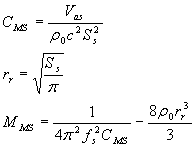
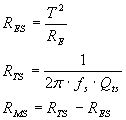
where
fs is the resonance of the loudspeaker
element in free air
Vas is the equivalent volume of the cone
suspension
T is the force factor AKA Bl
Qts is the total Q value of the loudspeaker
element
RE is the DC resistance of the voice coil
Ss is the equivalent piston area of the
loudspeaker element
rr is the piston radius corresponding to
Ss
Note that the
mechanical mass MMS is reduced by the amount of the co-oscillating
air for a piston in free air. Co-oscillating air is later added in terms of MAL.
Voice coil losses
The voice coil
inductance can be modelled as lossy. Measurement of real voice coils show that
the impedance behaves far from a simple resistor in series with an inductance.
A more appropriate model also takes into account "eddy currents"
induced in the magnetic pole pieces in the loudspeaker. A much better model is
to use this equation for the voice coil impedance
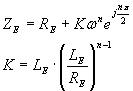
Where n is the loss
factor. If n=1 the voice coil is lossless and the impedance is RE+jwLE, however most loudspeakers have a
n value of 0.6 to 0.7. The main drawback with using this equation is that
manufacturers rarely specify the voice coil inductance in this way. Thus in
order to take advantage of the improved precision provided by the refined
model, the simulation has to be matched against measured data, e.g. in terms of
an impedance curve.
Voice coil temperature
The voice coil
resistance Re varies with temperature. Basta! can simulate this by
assuming that the voice coil resistance is proportional to the absolute
temperature. The Actual Re is modelled as
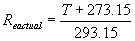
where T is the
temperature in °C. Modifying the temperature setting is
equivalent to adding a series resistance, e.g. by the L-pad.
Box
The box can be either
of a closed box, bass-reflex box, 1-ported band pass box or a 2-ported band
pass box.
Closed box
The closed box is
simulated by an acoustic compliance CAV simulating the cavity and an
acoustic resistance RAV corresponding to resistive losses within the
box, e.g. from damping material. Two masses MAL corresponding to the
co-oscillating air on the in- and outside of the box are included, as well as
one radiation resistance RAL. MAL and RAL are
derived from the radiation impedance of a pulsating sphere. The power dissipated
in the radiation resistance corresponds to the radiated acoustic power of the
system. The component values are calculated as follows:
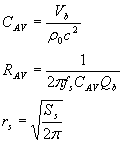
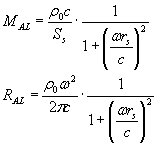
where
Vb is
the box volume
Qb is
the Q-value that would occur if fs was determined by CAV
and RAV was the only loss
rs is
the equivalent radius of the pulsating half-sphere.


The closed box and the equivalent circuit diagram of its acoustic load.
The simplified
transfer function of the closed box design behaves like a second order high
pass filter with a slope of 12 dB/octave at low frequencies.
Bass-reflex box
The bass-reflex box is
simulated using the same connection of the acoustic compliance CAV
and damping RAV as for the closed box. Part of the flow into the
box, passes out through the tube, and thus the vent is connected in parallel
with CAV and RAV. The radiation resistance is connected
in the box branch since the net flow into the surroundings is Qs-QB,
ie the difference between the flow out of the loudspeaker element and the flow
out of the vent. This net flow forms the useful flow of the system, and thus
the radiation resistance is connected there. In case of the more advanced vent
model, the third connection of the vent ensures that Qs-QB
rather than Qs-QA flows through the radiation resistance,
see diagram. The radiation resistance is now calculated using the radius of the
loudspeaker, since the loudspeaker delivers the major part of the flow at high
frequencies. The part of the radiation resistance that contains the radiator
radius is only important towards higher frequencies.

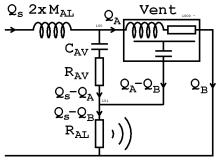
The bass-reflex box and the equivalent circuit diagram of its acoustic load.
The simplified
transfer function of the bass-reflex design behaves like a fourth-order high
pass filter with a slope of 24 dB/octave at low frequencies.
1-ported band pass box
The simulation of the
1-ported band pass box is similar to the bass-reflex box, but the radiation
resistance is moved to the flow coming out of the vent (QB) and an
extra cavity and damping represented by CAV2 and RAV2 is
added. There are two main differences from the bass-reflex box; since QB
now determines the flow to the surrounding air, the radiation resistance is
moved to this branch. Also, CAV2 and RAV2 add extra
compliance and resistance to the loudspeaker element, and thus provide an extra
possibility for the designer to affect the response of the system.
The radiation
resistance is now calculated using the radius of the port, rather than the
radius of the loudspeaker.
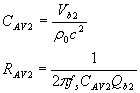
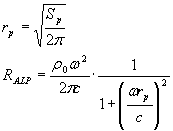
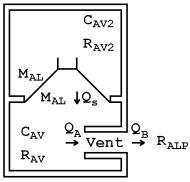

The 1-ported band pass box and the equivalent circuit diagram of its acoustic load.
The simplified transfer
function of the 1-ported design behaves like a fourth-order band pass filter
with slopes of 12 dB/octave at low frequencies and -12 dB/octave at high
frequencies.
2-ported band pass box
The simulation of the
2-ported band pass box is similar to that of the 1-ported band pass box, but
also has a vent in the second cavity. The second vent is connected in parallel
with CAV2 and RAV2 and forms a symmetrical diagram,
corresponding to the symmetrical design of the box. However, the two vents must
be tuned to different frequencies. Just as the vent in the bass-reflex design
provides the advantage of an extended low-frequency response compared to the
closed box design, the second vent in the 2-ported design provides an extended
low-frequency response as compared to the 1-ported box.
The radiation
resistance is now calculated using the radius of the Vent1, so the highest
helmholtz frequency should be assigned to Vent1, in this way this vent will
dominate the radiation at higher frequencies.


The 2-ported band pass box and the equivalent circuit diagram of its acoustic load.
The simplified
transfer function of the 2-ported design behaves like a sixth-order band pass
filter with slopes of 24 dB/octave at low frequencies and -12 dB/octave at high
frequencies.
Vent models
The tube vent can be modelled as a lumped mass or as a tube. The lumped mass model is accurate enough for low frequencies, and provides quick calculation of the response curves. The tube model provides extra information regarding resonances that occur in the tube, typically when tube the length corresponds to multiples of l/2. The vent can also be realised as a passive radiator.
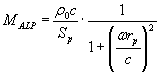
Note that the co-oscillating air MALP is included in the model of the vent, but that the radiation resistance is treated separately in the other parts of the analogue circuit diagrams.

Symbol for the vent model used in Basta! It symbolises the vent mass and losses, and a compliance distributed along these. The vent can be modelled as a lumped mass, a tube or as a passive radiator.
Lumped model
The lumped model is
activated by setting the number of sections of a vent to zero. In this case the
vent is modelled by a mass MAP and a resistance RAP, the
flow out of the tube is the same as the flow into the tube and thus the air in
the tube is considered as being incompressible.
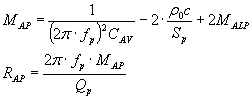
The equations for the acoustic mass and resistance of the port. Note that two end corrections first are removed from the mass, to model the air contained inside the tube. Thereafter the better model is added, this yields a better precision at higher frequencies.
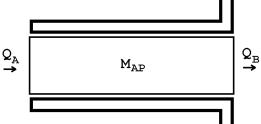
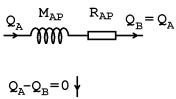
The lumped mass model and the equivalent circuit diagram of its acoustic properties.
In this case the air
inside the vent is assumed to be incompressible and thus if air that flows into
the vent at one end the same amount immediately flows out of the other end.
This model is fast and accurate for low frequencies.
Tube model
If the air inside
the tube is allowed be compressed, the model can simulate standing waves
("pipe resonances") within the tube. In its simplest form, the mass
and resistance are split in two, and an acoustic compliance CAP
corresponding to the volume of air inside the tube is connected in between the
two halves. This model can in principle simulate the first pipe resonance, but
the resonance frequency will come out slightly too low.

Setting the number
of sections of the vent to one activates this simple tube model. The difference
between incoming flow QA and outgoing flow QB represents
the compression of the air inside the tube and flows out of the third branch.
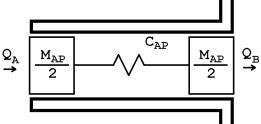

The simple tube model of the vent and the equivalent circuit diagram of its acoustic properties.
The tube model can
be expanded to simulate higher order resonances as well. In this case the tube
is split in several consecutive sections according to the figure. A higher
number of tube sections will make the calculation process slower, but will
increase the accuracy of the resonance frequencies.
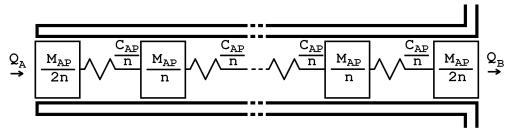

The generalised tube model of the vent and the equivalent circuit diagram of its acoustic properties.
Passive radiator
The vent can also be
realised as a passive radiator. In this case, no tube resonances will appear.
An extra compliance CASP is added, originating from the suspension
of the cone. Just as for the lumped model the flow into the inside the radiator
is the same as the flow out of the outside. Contrary to the lumped model of a
tube, this model is accurate also for higher frequencies, as there are no tube
resonances.
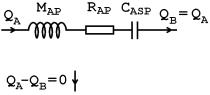
The passive radiator model of the vent and the equivalent circuit diagram of its acoustic properties.
Multiple loudspeaker elements
Basta! can simulate
acoustic coupling of multiple loudspeaker elements, both in parallel and
isobaric operation. By connecting n elements in parallel the maximum sound
pressure of the system is increased a factor n2, or 6 dB for two
loudspeakers, 12 dB for four loudspeakers, etc. The efficiency is increased a
factor n in the same configuration, but the box volume must be increased a
factor n in order to maintain approximately the same frequency response as for
the single loudspeaker system. As an alternative the loudspeakers may be
mounted in the isobaric configuration. Using this configuration for two
loudspeakers, the box volume can be halved, at the cost of a halved efficiency.
However, since the electrical power handling capacity is doubled, and the
maximum cone excursion remains the same, the maximum output sound pressure also
remains the same.
In Basta! the electrical
connection of the loudspeakers is expressed as the number of loudspeakers that
are connected in series. They are always connected in such a way that each
driver receives the same voltage. For example, if six drivers are used and
three are connected in series, two such branches of three drivers are connected
in parallel.
For multiple elements,
the equivalent Vas, T, Ss, RE and LE
values of the combined driver are derived from the single element. Given that
a is the number of elements that are connected
in series, electrically,
b is 1 for parallel configuration 2 for
isobaric configuration and
n is the total number of elements,
the new values are
calculated as:
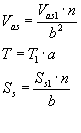

where sub-index "1"
corresponds to the parameter of a single loudspeaker element.
|
b=1, n=2 |
b=2, n=2 |
b=2, n=4 |
|
|
|
|


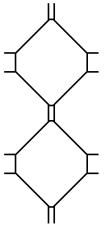
Acoustic connection of loudspeakers for some configurations. To the left, the loudspeakers are connected in parallel configuration, middle; isobaric configuration and to the right a combination of parallel and isobaric configuration.
|
a=2, b=1, n=2 |
a=2, b=2, n=2 |
a=1, b=1, n=2 |
|
|
|
|
|
a=1, b=2, n=2 |
a=3, b=1, n=6 |
|
|
|
|
|


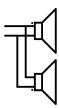

Electrical connection of some configurations. Note the reversed polarity for half of the elements in isobaric configuration.
Baffle step
When a driver is
mounted on a baffle, the driver will roughly radiate in half space at high frequencies,
but in full space at low frequencies. The result of this is an increase of 6 dB
of the high frequencies. The response curve, starting at 0 dB at low
frequencies and ending at + 6 dB at high frequencies, is commonly called the baffle
step.
Basta! can model the
baffle step, and uses a simplified version of the Geometric Theory of
Diffraction (GTD). In short, a number of secondary sources are placed around
the edge of the baffle, each having an amplitude and phase shift depending on
the baffle shape. The resulting baffle step is thereafter added to the other
response curves from Basta!.
Room gain
The room gain is
represented by two poles and two zeroes and is added to the different response
curves. The red explanatory curve below illustrates a pole pair at 20 Hz, Q=5
and a zero pair at 100 Hz, Q=5. Normally lower Q values are used; the default
(black) curve has a smooth lift of the response towards lower frequencies.

Design suggestions
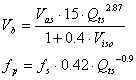
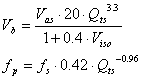
Basta! implements
three commonly found design equations for vented boxes. These suggest the box
volume and the vent tuning. The equations are:
Öhman:
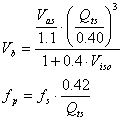
Keele:
Margolis/Small:
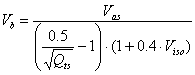
For the closed box, the
box volume that results in Butterworth response under free field conditions (ie
Q=0.7071) can be suggested from
Maximum output level
Basta! allows for
calculation of the maximum output level of the system. It is calculated based on
these limits:
Maximum peak cone excursion
Maximum electric RMS power in RE
Maximum RMS voltage from the power amplifier
Maximum RMS velocity in the vent(s)
Maximum RMS excursion of the vent(s)
The maximum output
level is the highest level at which none of these limits are exceeded.
Curves
|
Curve |
Unit |
Note |
Explanation |
|
System response |
dB |
@ 1 m re
20 mPa |
Sound pressure level
as it would be measured straight in front of the loudspeaker |
|
Max output level
(MOL) |
dB |
@ 1 m re
20 mPa |
Maximum possible SPL
straight in front of the loudspeaker |
|
Speaker voltage |
V |
|
The voltage across
the speaker terminals |
|
Speaker voltage at
MOL |
V |
|
The voltage across
the speaker terminals required to reach MOL |
|
Amplifier voltage |
V |
|
The voltage across
the amplifier terminals |
|
Amplifier voltage at
MOL |
V |
|
The voltage across
the amplifier terminals required to reach MOL |
|
Box (2) pressure |
dB |
re 20 mPa |
The sound pressure
inside the box. To measure this pressure with a microphone and compare it
with the Basta! simulation can be a way to verify the response of a system,
without having access to an anechoic chamber. |
|
Box (2) pressure at
MOL |
dB |
re 20 mPa |
The sound pressure inside
the box at max output level. This SPL is commonly very high, typically
140-160 dB. |
|
Speaker response |
dB |
@ 1 m re
20 mPa |
The part of the
sound pressure level originating from the loudspeaker element. |
|
Cone excursion |
mm |
|
The RMS movement of
the loudspeaker cone |
|
Cone velocity |
m/s |
|
The RMS velocity of
the loudspeaker cone |
|
Cone excursion at
MOL |
mm |
|
The RMS movement of
the loudspeaker cone at max output level |
|
Cone velocity at MOL |
m/s |
|
The RMS velocity of
the loudspeaker cone at max output level |
|
Vent (2) response |
dB |
@ 1 m re
20 mPa |
The part of the sound pressure level
originating from the vent as it would be measured straight in front of the
speaker. |
|
Vent (2) excursion |
mm |
|
The RMS movement of
the vent |
|
Vent (2) velocity |
m/s |
|
The RMS velocity of
the vent |
|
Vent (2) excursion
at MOL |
mm |
|
The RMS movement of
the vent at max output level |
|
Vent (2) velocity at
MOL |
m/s |
|
The RMS velocity of the
vent at max output level |
|
Speaker baffle step |
dB |
94 dB added. |
The baffle step that
results from the dimensions of the baffle and the driver placement. |
|
Vent (2) baffle step |
dB |
94 dB added. |
The baffle step that
results from the dimensions of the baffle and the vent placement. Usually
this curve is of little practical concern, since the vent mostly radiates
well below the frequencies where the baffle step is active. |
|
Electrical impedance |
W |
|
This impedance is
calculated as ua/ia, thus excluding the AC-bass
circuit, but including the passive
electric circuit. |
|
Electrical
inductance |
mH |
|
The reactive part of
the electrical impedance, seen as an inductance ie divided by w. This curve can be useful if the
manufacturer has specified the voice coil inductance as the inductance at two
different frequencies. |
|
Electrical
resistance |
W |
|
The resistive part
of the electrical impedance |
|
Electrical reactance |
W |
|
The reactive part of
the electrical impedance |
|
RE power
margin |
dB |
|
The level increase
allowed to reach the power limit in RE. |
|
Cone excursion
margin |
dB |
|
The level increase
allowed to reach the cone excursion limit. |
|
Vent (2) excursion
margin |
dB |
|
The level increase
allowed to reach the vent excursion limit. |
|
Vent (2) velocity
limit |
dB |
|
The level increase
allowed to reach the vent velocity limit. |
|
Overall margin |
dB |
|
The level increase
allowed without exceeding any of the limits. This curve is the difference
between the MOL and system response curves. |
|
Room gain |
dB |
|
The room gain (bass
lift) approximation as selected on the room gain tab. |
Note: If the baffle
step is not enabled, all sound pressure levels outside the box are based on
that the loudspeaker is mounted in a wall or floor and thus radiates in half
space (2p). If the baffle step is enabled, the loudspeaker box is assumed to
radiate in free field.
List of symbols
|
Symbol |
Explanation |
|
Rac |
Resistance determining the resistive losses
in the AC-bass system |
|
Racneg |
Negative output resistance
of the AC-bass circuit |
|
Lac |
Inductance of the
AC-bass circuit. Determines the effective compliance of the AC-bass system |
|
Cac |
Capacitance of the
AC-bass circuit. Determines the effective mass of the AC-bass system |
|
LL1,LL2 |
Inductors in passive
lowpass filter |
|
CL1,CL2 |
Capacitors in
passive lowpass filter |
|
RL1,RL2 |
Resistances in
passive lowpass filter, eg in the inductors |
|
LH1,LH2 |
Inductors in passive
highpass filter |
|
CH1,CH2 |
Capacitors in
passive highpass filter |
|
RH1,RH2 |
Resistances in
passive highpass filter, eg in the inductors |
|
Rs,Rp |
Series and parallel
resistances for passive attenuation |
|
REC,CEC |
Resistance and
capacitance of the conjugate link |
|
RE |
DC resistance of the
voice coil |
|
LE |
Inductance of the
voice coil |
|
n |
Loss factor of the
voice coil inductance |
|
T |
Force factor of the
loudspeaker. Also known as Bl |
|
RMS,CMS,MMS |
Mechanical
resistance, compliance and mass of the loudspeaker. MMS does not include
any co-oscillating air. |
|
Ss |
Equivalent piston
area of the loudspeaker cone |
|
fs |
Resonance frequency
of the loudspeaker in free air |
|
Vas |
Equivalent volume of
the loudspeaker. This volume would give a compliance equal to CMS,
given the equivalent piston area Ss. |
|
Qts |
Total Q-value of the loudspeaker in free air,
and zero series resistance. |
|
rr |
The radius of a
circular membrane that corresponds to Ss. |
|
ZE |
The impedance of the voice coil, neglecting the
effects of the mechanical system. |
|
MALS, MALP,
MALP2 |
The acoustic mass of the co-oscillating air
for the loudspeaker, first vent and second vent. This mass corresponds to the
reactive part of the radiation impedance. |
|
RAL |
The radiation resistance.
|
|
|
|
|
|
|
|
|
|
|
|
|
|
|
|
|
|
|
|
|
|
|
|
|
|
|
|
|
|
|
|
|
|
|
|
|